Summary: Identification of birds and other wildlife involved in aircraft strikes is an important part of the overall assessment and management of wildlife mitigation at airports. Knowing the exact species provides guidance to the size, behavior, and ecology of the animal in question and is key to tracking species trends as well as focusing preventative measures. Species identifications provide the baseline data needed to plan habitat management on airfields, build avoidance programs, and have even been used to assist engineers in designing windscreens and engines that are more resilient to birdstrike events.
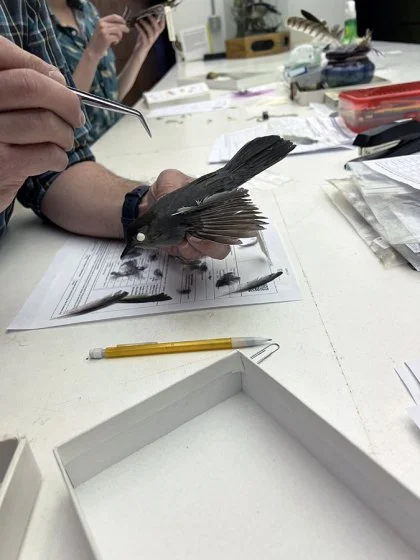
The Smithsonian Institution’s Feather Identification Lab is a highly specialized lab that processes over ten thousand wildlife strike cases annually. The FIL identifies the species involved in strikes using both whole and fragmentary feather material, as well as small amounts of blood and tissue containing DNA . Funding for the lab is supported by interagency agreements between the Smithsonian Institution, U.S. Air Force, U.S. Navy, and the Federal Aviation Administration.
About Our Speaker: Carla Dove, Ph.D., is the Program Manager for the Smithsonian Institute’s FIL. Dr. Dove received her B.S. at the University of Montana and her M.S. and Ph.D. at George Mason University, As a forensic ornithologist, her special research interests are in the microscopic identification of feathers. Current research involves establishing techniques in this newly developing field within Ornithology, which applies forensic methodologies to determine species of birds from fragmentary evidence using microscopy, whole feather comparisons with museum specimens and DNA 'barcoding'. The most important application of this research is to the field of aviation safety and determining identifications of birds that are ingested into aircraft engines (birdstrikes).